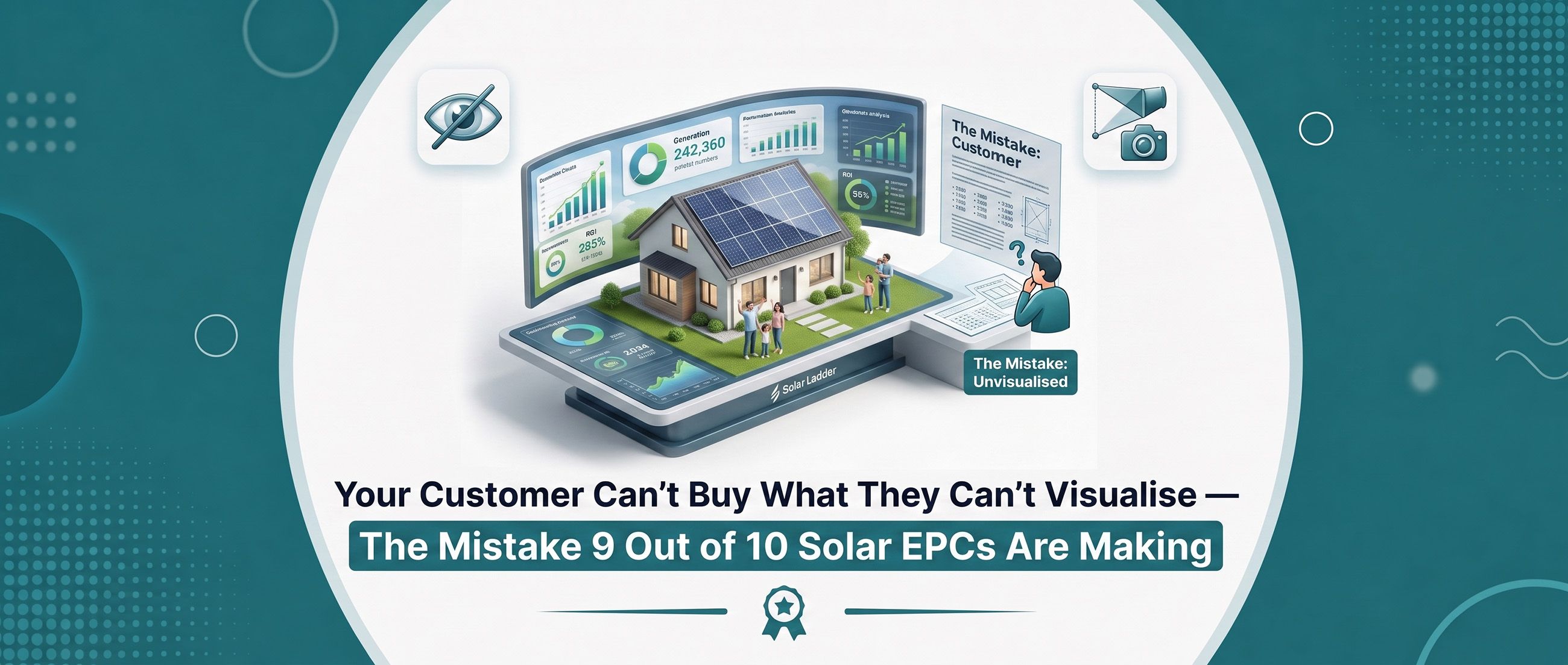
TL;DR Most Indian solar deals fail because of a "visualization gap." Customers hesitate to spend lakhs on systems they can’t picture. EPCs using Solar Ladder close faster by replacing generic PDFs with 3D rooftop designs and shadow analysis. Showing a customer their specific roof with accurate panel placement builds trust, eliminates doubts, and secures deals without needing deep discounts.
I've seen this exact situation play out hundreds of times across EPCs on Solar Ladder.
The EPC does everything right. They show up on time. They take measurements, check the meter, note the customer preferences. They go back to the office, build a quote, and send it across within a day or two. They follow up twice. Maybe three times.
The customer responds: "Looks good. Let me think about it and get back to you."
Two weeks pass. Then a month. The EPC drops the price by ₹15,000 hoping that moves things. It doesn't. The deal quietly dies.
The EPC assumes it was a price problem. Or that the customer wasn't serious. Or that a competitor undercut them.
Almost always, they're wrong.
The Real Reason the Deal Died
The deal died because the customer couldn't see the value of what they were buying.
Not the price. Not the brand of panels. Not even the EPC's reputation. The fundamental problem was that the customer was being asked to commit ₹2 lakh to ₹8 lakh to something they could not picture in their mind.
Think about what the customer actually received. A PDF. A system size. A price. Maybe a generic photo of some solar installation from the internet.
Now think about what was going through their head when they opened that document.
Where exactly will the panels go on my roof? Will it take the entire space? There's a water tank in the corner and a neighbour's building that casts shade in the afternoon — will that affect the output? The EPC said I'll generate 400 units a month, but is that on MY roof or just a general estimate?
None of those questions were answered. And a customer sitting with unanswered questions at a ₹8 lakh decision doesn't go ahead.
The Silent Deal-Killer Nobody Talks About
This is what I call the visualisation gap. And it is the single most underestimated reason solar deals fall through in India today.
EPCs spend enormous energy optimising their pricing, their panel brands, their warranties. Almost none of them invest in helping the customer actually see the system before it's installed.
The result is predictable. Sales cycles stretch from two weeks to two months. Discounts get offered to create urgency that should have been created by clarity. Conversion rates stay frustratingly low. And nobody connects it back to the real cause.
When a customer can't visualise, they hesitate. When they hesitate, the deal cools. When the deal cools, the EPC drops price. And now you're losing margin on a deal you should have won at full price.
What Changes When You Show the Customer Their Roof
Now picture the same customer, but this time the EPC shows up — or sends a proposal — with their actual rooftop modelled in 3D.
The customer sees their own roof. Panels placed accurately across the usable surface. Orientation and tilt shown clearly. The shadow from the water tank mapped out, with the exact percentage of generation loss it causes. A monthly generation number calculated for their specific roof, not a thumb rule.
Something shifts immediately. The customer starts trusting!
The questions disappear. The hesitation dissolves. The customer stops asking "will this work?" because they can see that it will. The conversation moves from "let me think" to "what are the next steps?"
That is not a small change. That is the difference between a deal that closes and one that doesn't.
My Honest View on Where This Industry Stands
Selling solar in 2026 without showing the customer a visual of their system is the equivalent of a builder asking you to book a flat without showing you a floor plan. Nobody would accept that. And yet in solar, we've normalised it.
Expecting a customer to imagine a ₹5 lakh to ₹15 lakh system on their own roof — based on a PDF and a site visit — is not just ineffective.
Solar rooftop visualisation for clients isn't a premium feature anymore. It's the baseline expectation. The EPCs who understand this are closing faster, discounting less, and building far stronger customer relationships.
What the Industry Standard Should Look Like
This is exactly why Solar Ladder is built the way it is.
When an EPC uses Solar Ladder, the customer doesn't receive a generic quote. They receive a proposal built around their specific roof — a 3D solar design showing exact panel placement, a shadow analysis identifying shading losses from surrounding structures, a generation forecast tied to their actual roof orientation, and savings projections based on their real consumption.
The customer sees their rooftop. Not a rooftop. Theirs.
900+ EPCs across India are generating proposals like this today — in minutes, not days. The feedback is consistent: customers engage differently. They ask fewer doubtful questions. They make decisions faster. They stop negotiating on price because value has already been demonstrated visually.
This is what showing how to show solar panel placement to a customer actually looks like in practice. Not a verbal explanation during a site visit. A rendered, data-backed visual that travels with the proposal and answers every question before it's asked.
The Closing Truth
The solar market in India is only going to get more competitive. More EPCs, more options, more customers doing their own research before they pick up the phone.
In that environment, the EPC who shows wins. The one who tells, loses.
If your customer can't see it, they won't buy it. It's that simple.
Solar Ladder — Instant proposals. 3D rooftop design. Shadow analysis. Built for Indian EPCs. www.solarladder.com
Frequently Asked Questions
Many customers hesitate because they can’t clearly visualise how the solar system will look and perform on their own roof. Without a rooftop layout or visual proof, uncertainty delays decisions.
EPCs can use 3D solar design software like Solar Ladder to create rooftop layouts that show exact panel placement, orientation, and system size tailored to the customer’s property.
Shadow analysis shows how nearby objects affect energy generation. When customers see this visually, it increases transparency and confidence in the system’s performance.
Even with accurate pricing, deals are often lost because customers lack clarity and confidence. Without visualisation, the proposal feels abstract and harder to commit to.