TL;DR Soft costs like failed site visits, redesigns, and operational delays are silently reducing solar EPC margins in India. While hardware prices are low, profits leak through inefficiencies. By using automation, accurate site surveys, 3D design, instant proposals, and integrated CRM, EPCs can reduce waste and improve profitability in 2026.
The Hidden "Margin Killers" in Your Business
Most Indian installers focus on getting a better deal on modules, but the real profit-draining inefficiencies are hidden in the project lifecycle.
1. The Site Visit Sinkhole (The Conversion Crisis)
The biggest drain on an Indian EPC’s resources isn't the project they build, but the ones they don't. In the current market, it is estimated that 95% of site visits do not convert into a final sale. Installers spend thousands of rupees on fuel, engineer salaries, and travel time, only for the customer to say "no" or choose a competitor. Because these cancellations often happen before any hardware is ordered, they represent a massive chunk of wasted pre-installation soft costs. Every failed visit is an investment with zero ROI that eats directly into the profits of the projects you actually close.
2. The Profit-Eating Rework (The Change Order Trap)
Few things disrupt an installer's profitability more than "change orders"—when a project needs to be redesigned because the initial plan doesn't match the customer’s final vision or the roof's reality. These are "silent margin killers" because they force your team to do the same work twice.
In the Indian context, these changes usually occur when a customer decides to:
- Shift the plant location to a different corner of the roof after seeing the initial layout.
- Increase the height of the structure to allow for better roof usage or cleaning.
- Add a metal sheet under the panels for extra waterproofing or insulation.
When your design team has to redraw models from scratch or your operations team has to make an extra "truck roll" to the site, your labor costs skyrocket while your margins vanish.
3. Operational Friction
Time is your most limited and expensive resource. Inefficient tools consume time quietly—whether it is a sales rep waiting days for a technical design or the engineering team manually redrawing rooftop models because the site survey notes were incomplete. These manual handoffs and delays give competitors the opportunity to step in and close the deal while you are still "processing" the paperwork.
How Solar Ladder Plugs the Margin Leak
To thrive in 2026, Indian EPCs must move away from manual spreadsheets and disjointed tools. Solar Ladder provides an all-in-one platform designed to eliminate these soft costs.
- Solar CRM: Stop losing leads to poor follow-ups. A visual sales pipeline helps you retarget leads and ensures no prospect is forgotten during the long decision-making window.
- Mobile Site Survey Form: Capture 100% accurate data—including exact GPS locations and high-resolution site photos—directly on your phone. This ensures the design team has everything they need, preventing repeat site visits.
- 3D Design & Instant Shadow Analysis: Create a "Digital Twin" of the roof on-site. By showing the customer the exact height and location of the plant in 3D, you eliminate the mid-project requests for changes in location or structure height.
- 1-Minute Custom Proposals: Using simple drop-down menus and default fields, you can generate a branded, professional proposal during the site visit. Closing the deal on the spot prevents the "I'll think about it" rejections that lead to high cancellation rates.
- Integrated Project Management: Connect your sales, design, and operations teams in one place. When a deal is won, the data flows automatically to the engineering team, reducing manual errors and saving hours of rework.
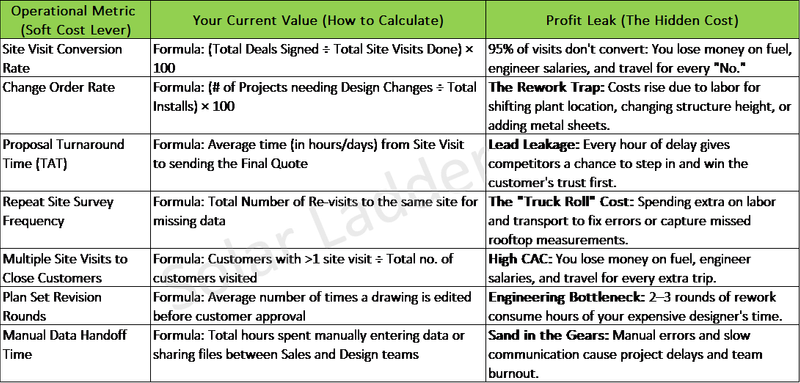
EPC Soft Cost Audit: Where Is Your Profit Leaking?
Use this table to audit your last 90 days of operations. Compare your current numbers to identify where you are losing the most margin.
Conclusion: Efficiency is the New Strategy
When margins are tight, ROI isn't just a financial concept—it is a survival strategy. By reducing soft costs through automation and precision, you can complete more projects with the same team and significantly higher profits.
Frequently Asked Questions
Solar Ladder reduces soft costs by digitizing the "heavy lifting." Instead of multiple site visits, you can use high-fidelity satellite 3D modeling. Instead of manual follow-ups, you use automated CRM pipelines. By reducing the time spent on administrative tasks, your team can handle 3x more projects with the same headcount, significantly lowering your operational overhead.